
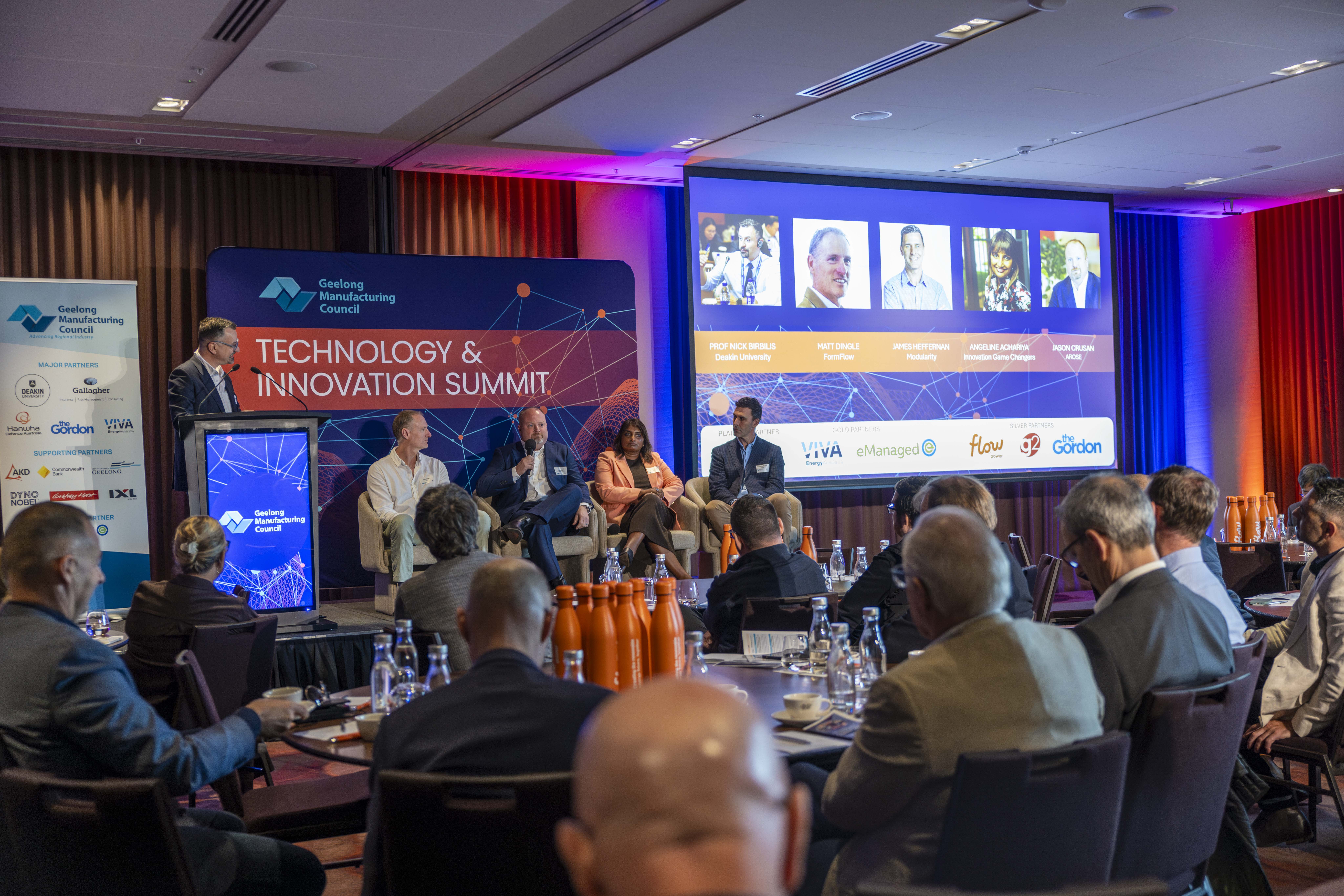
Australia’s future in high-value manufacturing took centre stage at GMC’s 2026 Technology & Innovation Summit, where a series of panels and keynotes not only energised the audience but sparked new ideas, partnerships and momentum across the sector.
Speaking later, Emeritus Professor Roy Green AM, said: “The GMC Technology and Innovation Summit is an event that should inspire Australians to believe that we can be globally competitive in high value manufacturing. Because many who attend the Summit are already the best in the world at what they do, and many others are creating the industries and jobs of the future.”
The BOLD solutions panel, chaired by Worley’s Dr Clare Anderson, shared significant circular economy and energy solutions already in the market, including many highly innovative solutions developed in Geelong. There was a shared view that manufacturers would gain a great deal from thinking about an energy strategy.
Inspirational local manufacturers: “the best in the world at what they do”
Emeritus Professor Roy Green AM
Vanessa Lenihan, as the Head of Future Fuels and Decarbonisation at Viva Energy, shared developments at Viva in converting used cooking oil into food grade packaging for snack food companies. Building the logistics supply chain – such as Viva’s work with Cleanaway to transport the used cooking oil – was often the biggest barrier to successful project development, and one that is frequently underestimated in both its complexity and importance.She said that through leadership and combined commitment, the company had pulled it off.
Shaun Cumming, Managing Director at Barwon Water, shared the strong business case for water efficiencies and recovering waste-heat energy from the sewer network. The investment in infrastructure provides security of supply and pays off in the short term. “There are economic ways to solve environmental challenges,” he said.
Travis MacLachlan, from FlowPower, encouraged companies to take opportunity from the current chaos. The FlowPower electricity retailing model focuses on demand flexibility and wholesale market transparency to help customers reduce costs.
Andrew Davies said Li-S Energy had spent $40 million in commercialising its new battery technology. He was highly optimistic about Australia’s ability to “re-arm”, in an industrial sense – to build local capability.
The day’s VISIONARY opportunities panel was an eclectic discussion around systems and new thinking. Jason Crusan, 25 years with NASA, now CEO of Australian Remote Operations for Space and Earth, said systems engineering was a critical discipline that could be instrumental in developing Australia’s knowledge economy – because it ensured complex projects work as an integrated whole, linking design, operations, and long-term outcomes rather than treating components in isolation.
Angeline Achariya, CEO of Innovation Gamechangers and food industry leader, emphasised the need for a systems approach to food manufacturing. She also urged a change in the way we approach exporting: “We need to rethink the model of exporting – bilateral commercial relationships need to be grounded in long-standing relationships not just transactions.”
Matt Dingle, founder of FormFlow, and James Heffernan, GM of Modularity at Rendine, urged a new approach to building housing in Australia. The two are working on making housing fast, affordable, high quality and exponentially more efficient, embedding the principles of manufacturing into the highly inefficient construction sector.
Matt noted that, in productivity terms, the same workforce is now delivering only half as many homes as it did 30 years ago.
Pre-fab and modular had not yet yielded the right outcomes for housing – partly because of approvals and inspection delays, but importantly it was the absence of standardised designs that reduced efficiencies. Matt noted that the State Savings Bank of Victoria played a major role in delivering housing at scale from the 1920s to the 1960s, financing and building thousands of homes for lower- and middle-income Victorians. This demonstrated what coordinated delivery could achieve.
Session chair, Professor Nick Birbilis, asked panellists what they would wish for if they had a magic wand. Angeline called for every dollar invested in R&D in Australia to be matched with a commercial partner, ensuring stronger pathways to market. Jason took a different tack and advocated for more “blue sky” thinking to unlock greater value from Australia’s natural resources.
James Heffernan emphasised the need for long-term government commitment to modular housing, supported by a coordinated policy framework that provides clear direction to industry.
Summit attendees were welcomed back from lunch with an enthusiastic speech from Geelong Mayor Cr Stretch Kontelj.
Andrew Jones, G2 Innovation, followed this with an energetic motivational pitch to “stop managing the pressure, start designing game-changing performance.” Andrew, a mechatronics engineer, shared real world manufacturing examples that had unlocked capacity and transformed businesses.
He challenged leaders to encourage an innovation culture among their teams – but innovation needed a clear business strategy, he said. “Peter Drucker [management expert] famously said culture eats strategy for breakfast. But I say: culture goes hungry without a strategy,” Andrew said.
The final panel was another major highlight of the day – the TRAILBLAZERS panel – chaired by Deakin University’s Director, Defence and Security, Strategic Partnerships, Dr James Mullins. The group included three local manufacturing heroes: Jack Fitzgerald, founder of innovative local company, Think Manufacturing; Samantha Van Zyl, CEO of growing textiles innovator, LoomTex; and Ryan Veale, Lead Engineer – C4I Systems, Hanwha Defence Australia.
Being passionate about manufacturing – and belonging to a strong regional ecosystem – was a major theme of the lively discussion. Jack, in true eco renegade style, shared real life business stories and the company’s journey in pioneering and commercialising recycled products.
Samantha described her unconventional pathway into manufacturing – from running luxury $100,000 plus surfing holidays, to managing logistics for the Para Olympics, and now leading what is arguably one of Australia’s most innovative textile manufacturing ventures. She said staying regional was important to her personally and to the company. Manufacturing is about relationships and partnerships; there are measurable benefits to a close-knit community like the Geelong region.
Ryan, a Deakin graduate, said Deakin University and the region’s broader industrial ecosystem had strongly supported his career development, from his days as a senior engineering student participating in Deakin’s SPARK accelerator program. Being part of a regional community also gave him close access to industry, mentors and real-world opportunities, helping him build practical experience and meaningful connections early in his career.
Read more:
National thought leaders converge at GMC Summit
Starting, Scaling and Succeeding with AI: Key Takeaways from Technology & Innovation Summit Day 1