

Deputy Prime Minister Richard Marles with Minister for Industry and Innovation, Senator Tim Ayres at GMC’s 2026 Technology & Innovation Summit in Geelong.
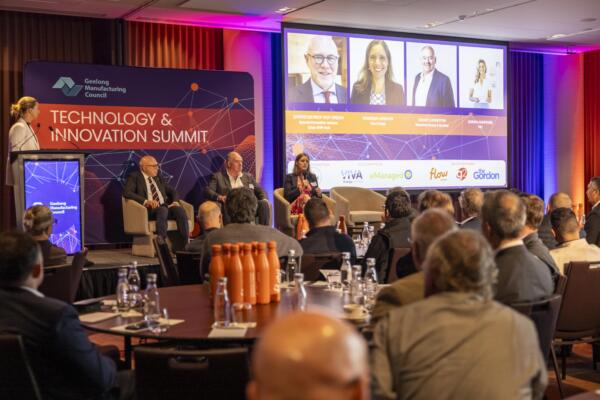
National influencers converged on Geelong for the 3rd biennial GMC Technology and Innovation Summit last week.
Geelong Manufacturing Council was pleased to welcome two Federal Ministers – the Minister for Industry and Innovation, Senator the Hon Tim Ayres, and our local Member for Corio, the Deputy Prime Minister and Defence Minister, the Hon Richard Marles – on Day 2 of the Summit on Thursday. More than 240 people took part in the 2026 T&I Summit over the two days.
Minister Ayres thanked the GMC for the opportunity to visit the region for the first time. He was able to speak to a number of leading companies at the event and later visited businesses building advanced high-value opportunities.
DPM Marles told the audience the Government had been arguing that as a nation we needed to turn manufacturing around, “and Tim has been very much at the forefront of this.”
“We’ve been deeply focused on reinvigorating manufacturing, based on where we saw the manufacturing of the future, the jobs of the future, the industries of the future. The NRF is our main initiative in that respect.
“If I can segue into Defence for a minute, Australia’s most consequential national security risk is less that the country would be invaded but more that a country that sought to do us harm might seek to coerce through disrupting our sea lines of communication,” he said.

The two Ministers shared a Q&A session and offered responses to several audience questions including: the challenge of enforcing local content in major projects; the ever-increasing compliance burden for manufacturers; and whether the NRF focus on capital was merely addressing a symptom rather than the problem’s root cause. GMC Deputy Chair Rob Backwell, in framing the question, argued that the main challenge for manufacturers was not, in fact, access to capital (which the NRF is set up to provide) but the high operating costs caused by regulation, taxes, industrial relations, and energy.
Export orientation critical to manufacturing success
As part of an influential thought leaders’ panel, Emeritus Professor Roy Green AM, one of Australia’s most respected voices in innovation and industrial strategy, shared the following statistics: Australia is home to just 0.3 per cent of the world’s population, yet we are responsible for more than 3 per cent of global research and at a higher quality than the OECD and the world averages. He defined industrial sovereignty in the broadest sense as contributing successfully to global value chains.
Grant Johnston pointed to the challenges facing fabricated steel manufacturers in Australia, competing with cheap imported product from countries with protected industries. He told the audience that his company, Alter Steel, was nevertheless committed to supporting Australian self-reliance and is in advanced planning for a major investment in a new electric arc steel mill in Queensland. The mill will reduce the carbon emissions of steel making from 2.2 tonnes of CO2 per tonne of steel in traditional blast furnaces down to approximately 0.3 tonnes of CO2 per tonne when using scrap steel and grid electricity.
Vanessa Lenihan said Viva Energy’s future depended, to a degree, on government support, while at the same time, the company’s biggest exposures are gas & electricity prices. Better government policies could be on the table for the transition to renewables. A more nuanced approach would support consumers, manufacturers being among the largest of these impacted.
“We have to be realistic about the costs of the transition,” she said. The complexity of regulations and contradictions between departments were not just impacting manufacturers but holding Australia back.
Other dynamic discussions followed, including a keynote from head of the National Reconstruction Fund, David Gall, who shared how the $15 billion government program was looking to incentivise commercial thinking and export-orientation from the outset.
Read more:
Bold, Visionary, Gamechangers and Trailblazers Panels
Starting, Scaling and Succeeding with AI: Key Takeaways from Technology & Innovation Summit Day 1