
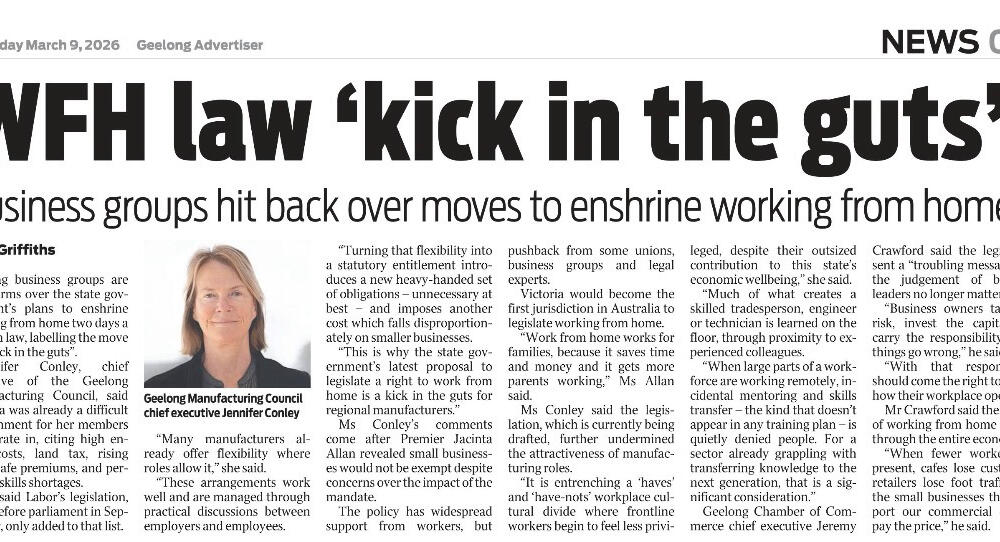
GMC CEO Jenn Conley was featured in the Geelong Advertiser and Herald Sun (Monday 9 March 2026) speaking about how the Victorian Government’s Working from Home laws – which come into effect on 1 September 2026 – will make it even more difficult for manufacturers to operate in Victoria.
She said high energy costs, land tax, rising WorkSafe premiums and persistent skills shortages had already made Victoria a difficult environment to operate in.
“Many manufacturers already offer flexibility where roles allow it, these arrangements work well and are managed through practical discussions between employers and employees. Turning that flexibility entitlement introduces a heavy-handed set of obligations – unnecessary at best – and imposes another cost which falls disproportionately on smaller businesses.”
Read GMC’s full response to the Working from Home laws below:
Regional manufacturers need a fair go, not more compliance
In manufacturing, the fundamentals are simple: safety, quality, delivery and productivity. Every hour spent improving those things strengthens a business. Every hour spent navigating new compliance obligations is an hour not spent running one.
For regional Victorian manufacturers, keeping that balance – time on the business versus time on compliance – is becoming harder to maintain.
Geelong Manufacturing Council works with manufacturers employing anywhere from a dozen people to several hundred. What we hear consistently is not resistance to good workplace practices or flexible employment arrangements. The concern is about the cumulative weight of regulation, and the management time (and expense) required to keep up with it.
Victoria is already a demanding environment in which to manufacture. Businesses face high energy costs, rising insurance premiums, land tax escalation, and persistent skills shortages. A CBD knowledge-economy firm may be able to absorb growing legal and HR compliance. A 40-person manufacturer in North Geelong cannot.
That context helps explain why the Victorian Government’s proposal to legislate a right to work from home has raised concerns among many regional manufacturers.
Most manufacturers already offer flexibility where roles allow it. In most cases these arrangements work well, and are managed through practical discussions between employers and employees. Turning that flexibility into a statutory entitlement introduces a different set of obligations. Even where a request is ultimately agreed to, the legislated process adds complexity and cost that falls disproportionately on smaller businesses.
There are also structural risks the proposal does not appear to adequately consider. If a role can be performed remotely from Geelong, it can often be performed remotely from anywhere, including lower-cost locations interstate or overseas. Legislating remote work without weighing that dynamic risks accelerating the very skills drain regional manufacturers are already fighting. The workers we most need to attract and retain are precisely those with the portable, high-value skills that remote work liberates from geography.
A second structural risk is closer to home. Regional manufacturing already faces a significant demographic challenge with an ageing workforce and persistent difficulty attracting younger workers into the sector. Much of what makes a skilled tradesperson, engineer or technician is learned on the floor, through proximity to experienced colleagues. When large parts of a workforce are working remotely, that incidental mentoring and skills transfer, the kind that doesn’t appear in any training plan, is quietly lost. For a sector already grappling with transfering knowledge to the next generation, that is not a minor consideration.
Regulatory uncertainty compounds the problem. When employment frameworks become more complex, businesses defer decisions on hiring, investment, and expansion. That hesitation has a real cost in regional communities.
There is a deeper contradiction here worth naming. The Victorian Government invested significantly in rebuilding Geelong’s manufacturing base after the major industrial closures of the last decade. That investment was deliberate and it has worked: advanced manufacturers across our region today are investing, employing and exporting. A new layer of compliance risk that falls hardest on exactly those businesses is in tension with that commitment, not because the policy intent is wrong, but because the burden lands in the wrong place.
Increasing workforce participation, supporting working families and reducing commuting pressure are legitimate goals. Flexibility, implemented well, benefits employers and employees alike. But if broader work from home participation is a public good, as the Government argues, the costs of delivering that policy should not fall disproportionately on the businesses least equipped to carry them.
Regional manufacturers are not asking for special treatment. They are asking for policy that accounts for the realities of running a factory: that some roles cannot be done remotely, that compliance costs are not trivial at scale, and that regional economies are not simply smaller versions of Melbourne.
The best policy settings are those that allow manufacturers to focus on productivity, innovation and workforce development, not on navigating yet another layer of obligation.
- SME management bandwidth is consumed by compliance rather than production & innovation.
- The WFH legislation may perversely make regional manufacturing less competitive as an employment choice relative to remote-enabled roles, accelerating the skills drain the sector is already experiencing.
- Regulatory uncertainty has a direct cost: it defers hiring decisions, investment decisions, and expansion decisions.
- If WFH participation outcomes are a public good (as the government claims), the costs and risks of delivery shouldn’t be disproportionately borne by the businesses least equipped to carry them.
- This proposed legislation is another example of a government adding complexity to businesses in communities that can least afford factory closures. This government invested in rebuilding Geelong’s manufacturing base after major closures and is now proposing (peversely again) to add more compliance and legal costs to the businesses that investment was designed to support.
Victorian regional manufacturers already operate at the intersection of every structural disadvantage the state imposes: last-ranked regulatory burden nationally; high energy prices; WorkCover premiums that have blown out ; land tax escalation; and chronic skilled labour scarcity.
The proposed WFH legislation adds a new layer of legal uncertainty and compliance risk that is categorically different in impact for a 40-person regional manufacturer than for a Melbourne CBD knowledge-economy firm. These regional businesses cannot offshore their operations (nor do we want them to), cannot pass costs on indefinitely if they wish to remain competitive, and cannot offer hybrid arrangements as a retention tool the way white-collar employers can. Adding state-based employment law complexity on top of an already last-place regulatory environment signals that Victoria has made a policy choice, whether it intends to or not, about which businesses it values.
Many employers already see Victoria as an unattractive place to invest.
Quite apart from the questions about whether Victoria legislating a right to Work from Home (WFH) is constitutionally valid, decisions about day-to-day workplace matters are best decided at a workplace level through discussion between employer and employees.
Many of our members dispute what appears to be an exaggerated claim made in the Premier’s press statement that “Day after day, unions are being contacted by workers who have been denied reasonable requests to work from home.” Indeed, members responding to our survey report they have never said no to someone who can work effectively from home for part of the working week.
If someone can WFH in Victoria, it is likely that role can be performed (maybe at meaningfully lower cost) in another jurisdiction (whether Brisbane or Bangalore).
Incidental mentoring and learning by example are denied for new starts and younger employees when people work at home.