
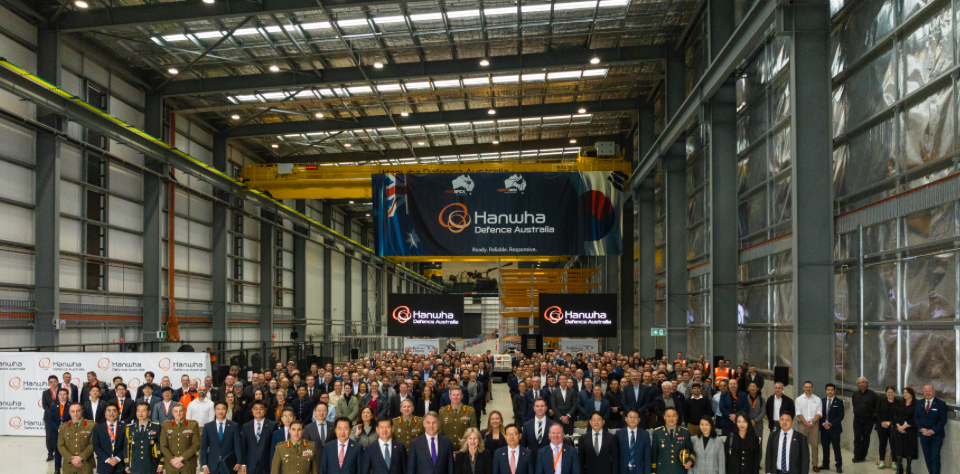
GMC major partner, Hanwha Defence Australia’s (HDA) investment in Geelong manufacturing jobs and capabilities is helping to thrust Geelong into the Korean spotlight, thanks to a major feature story in one of South Korea’s most prominent daily newspapers this month.
Geelong’s industrial transformation and rapid population growth are featured in The Dong-A ILBO (East Asia Daily), one of South Korea’s oldest and most influential daily newspapers.
GMC CEO Jenn Conley describes in the article how Geelong’s business leaders pulled together with government and academia to adapt industry stemming Geelong’s roots in wool, fibre and automotive into advanced materials and defence capabilities.
Geelong and South Korean ties continue to deepen following an MOU between Changwon City (South Korea’s industrial hub) and Geelong in 2022, the $200 million Hanwha Armoured Vehicle Centre of Excellence facility (H-ACE), links between Deakin University and Changwon National University, and many delegations between Geelong and South Korea to strengthen industrial, tourism, cultural and education opportunities.
Read the full Dong-A ILBO article below:
From Rust Belt to Australia’s Silicon Valley: How Geelong Engineered a 29% Population Boom
Part 4 of “Cities That Defied the Population Decline”
— Geelong’s Rebirth as a Advanced Manufacturing Hub
By Ji Yoon Lee [email protected]
Published Oct. 24, 2025
https://www.donga.com/news/Inter/article/all/20251024/132625668/2
The largest carbon-fiber manufacturing facility in the Southern Hemisphere, it produces advanced materials such as batteries and composites. The project builds on Geelong’s historic expertise in wool and fiber processing, reimagined for the modern era. (Courtesy of Deakin University)
“This is the Australian version of Silicon Valley.”
That’s how business leaders now describe Geelong, a southeastern industrial city in Victoria, about 75 kilometers from Melbourne, Australia’s second most populous metropolis after Sydney. Once known for its factories, Geelong today is home to a growing cluster of high-tech firms in defense, advanced materials, and clean energy. Its population and economy are booming.
Geelong’s 300,000 residents lives around the town that housed the sprawling plants of Ford Motor Co. and its suppliers for nearly a century. The city was long nicknamed “Australia’s Detroit,” after the heart of America’s car industry. But as globalization accelerated in the 1990s, auto plants shut down one after another, pushing the entire city into crisis.
Local authorities moved quickly to replace autos with defense, advanced materials, health care, and energy industries. A decade ago, in 2014, Reuters described Geelong as “a city at the crossroads between Detroit and Silicon Valley.” Today, the verdict is clear: the city has decisively turned toward the latter.
From Cars to Combat Vehicles, and From Wool to Carbon Fiber
When Ford permanently closed its factory in 2016, Geelong’s population was just under 240,000. In the ten years since, it has grown 28.7%, with roughly 20% of residents having moved in during the past five years.
One of the most visible signs of change came last August, when Hanwha Aerospace opened H-ACE, its first overseas production base. The plant manufactures the Redback infantry fighting vehicle and the AS9 Huntsman self-propelled howitzer for the Australian Army.
“Automotive and defense manufacturing share a lot in common — both are built around metalworking,” said Dean Michie, operations head at Hanwha Defense Australia. “This region has an abundance of highly skilled labor with the technical know-how and manufacturing experience to make that transition.”
Geelong’s roots in materials engineering also run deep. Beginning in the 1840s, the city exported wool to Britain and built up expertise in fiber processing. That tradition survives at Deakin University, the local engineering powerhouse, where researchers are developing advanced carbon-fiber technologies. Lighter and stronger than steel, carbon fiber is prized in defense, aerospace, automotive, and construction. The university’s facilities were sited here precisely because of the area’s long history in fiber manufacturing.
“Geelong’s business community never feared industrial decline,” said Jennifer Conley, CEO of the Geelong Manufacturing Council. “Government, industry, and academia all pulled together to build the foundations for new-generation industries. That’s what created the Geelong we see today.”
Roughly 30,000 residents, about 10% of the population, now work in health and medical services, a result of close coordination between city authorities and Deakin University in expanding both public and private hospitals. Locals say they no longer need to travel to Melbourne for high-quality care. Expectations are high for a new women’s and children’s hospital opening next year.
According to the National Institute of Economic and Industry Research, Geelong’s gross regional product grew at an average annual rate of 5.4% from 2018 to 2023, the fastest in Australia. Over the same period, job creation (5.1%) and population growth (2.2%) ranked first and second nationwide, respectively.
At the city center, Conflux Technology, a startup producing high-performance heat exchangers using patented 3D additive-manufacturing processes, supplies global clients including Airbus and Honeywell. “About 40% of our 55 staff came from outside Geelong,” said founder Michael Fuller. Asked why he started the company here despite having no local ties, he said: “The region has a rich talent pool, people are happy living here, and the infrastructure for doing business is exceptional.”
Affordable and Attractive for Young Families
Geelong’s proximity to Melbourne means residents can access big-city amenities while enjoying much lower housing costs. Real-estate firm PropTrack estimates that as of June this year, Geelong’s median house price stood at A$590,000 (about ₩550 million), roughly 70% of Melbourne’s median. Education options, from primary schools through university, are also strong.
Shabi, a resident in his 30s who relocated from Melbourne last year, said: “The quality of life is just as good, but it’s much cheaper and more nature-friendly. Moving my family here was the right decision.”
The city has invested A$667 million (about ₩620 billion) in urban-renewal projects and has plans to add 139,800 new homes. Mayor Stretch Kontelj said: “The city’s revival owes much to young families in their 30s and 40s choosing to settle here. If current trends continue, Geelong’s population will exceed 400,000 by around 2041.”
Deakin University’s Industrial Campus Becomes a Startup Powerhouse for AI, Defense, and Batteries
Deakin University has taken the lead in anchoring Geelong’s industrial revival by transforming its main campus into an innovation hub rivaling a full-scale industrial park. The goal: to commercialize university research and accelerate startup creation, ensuring promising technologies don’t stay in the lab. Working with government partners, Deakin has attracted high-potential firms through venture-capital funds. It is now pushing into defense, battery, and artificial-intelligence ventures.
At the Geelong Future Economy Precinct, Deakin’s manufacturing innovation hub, a cluster of facilities symbolizes this new direction. The ManuFutures startup incubator sits beside Carbon Nexus, a carbon-fiber plant producing battery, both powered by a 7.2-megawatt solar farm. The site also features a 1,000-amp electrical network to support energy-intensive activities such as AI research and prototype battery production.
Deakin built factories next to research labs to streamline collaboration between academia and industry. The Institute for Frontier Materials (IFM) hosts Australia’s first pilot-scale facility for custom-designed advanced batteries. Researchers at Carbon Nexus, working with Malaysia’s state-owned energy company Petronas, have also developed a self-healing coating that uses moisture in the air to automatically repair scratches and corrosion damage. The technology could extend the lifespan of offshore platforms, pipelines, and wind turbines while sharply cutting maintenance costs.
At ManuFutures, advanced-manufacturing, defense, and clean-tech startups each operate their own hub, starting from 50 square meters, scalable as their business grows. The incubator also pairs promising entrepreneurs with university researchers to accelerate commercialization.
Pointing to the curved steel façade of ManuFutures, Glynn Atkinson, Deakin’s director of entrepreneurship, business development, and commercialization, said: “That was developed jointly by our researchers and a startup founder.” The company, FormFlow, successfully commercialized a crack-free steel bending process and moved out from the incubator in 2021 after building its own facility. “Our goal is to produce 50 such successful ‘graduates’ over the next decade,” Atkinson said, “and in doing so, help Australia secure more home-grown industrial technologies.”
The university’s “startup industrial park” is also boosting its finances. According to Knowledge Commercialisation Australasia (KCA), Deakin earned A$120 million (about ₩110 billion) last year from equity holdings in startups. It’s the second-highest among Australian universities, behind only the University of Queensland. The model echoes that of Stanford University in Silicon Valley: a university-driven ecosystem linking research, entrepreneurship, and capital formation.